


APBMT 2026 | Dr. Tong Wu and Dr. Yongqiang Zhao's Team Reports Outcomes of Allo-HSCT in TP53-Mutated B-ALL
2026-10-16The 31st Annual Meeting of the Asia-Pacific Blood and Marrow Transplantation Group (APBMT 2026) was held in Manila, Philippines, from October 1 to 4, 2026.
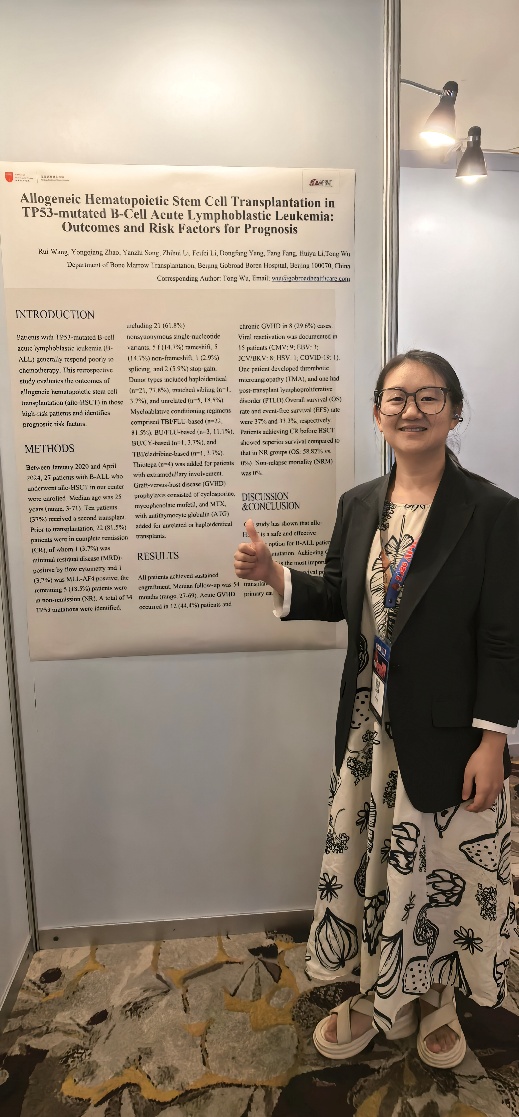
A study by Dr. Tong Wu and Dr. Yongqiang Zhao's team at Beijing GoBroad Boren Hospital, GoBroad Healthcare Group, titled “Allogeneic Hematopoietic Stem Cell Transplantation in TP53-mutated B-Cell Acute Lymphoblastic Leukemia: Outcomes and Risk Factors for Prognosis,” was selected for poster presentation.
The study evaluated transplantation outcomes and prognostic factors in patients with TP53-mutated B-cell acute lymphoblastic leukemia (B-ALL), a high-risk subtype associated with poor responses to conventional induction chemotherapy.
Study Information
Title: Allogeneic Hematopoietic Stem Cell Transplantation in TP53-mutated B-Cell Acute Lymphoblastic Leukemia: Outcomes and Risk Factors for Prognosis
First Author: Rui Wang
Corresponding Authors: Tong Wu, Yongqiang Zhao
Institution: Beijing GoBroad Boren Hospital, GoBroad Healthcare Group
Background
Patients with TP53-mutated B-ALL often respond poorly to induction chemotherapy and face a high risk of disease recurrence.
This retrospective study investigated the outcomes of allogeneic hematopoietic stem cell transplantation (allo-HSCT) in this high-risk population and explored factors associated with prognosis.
Methods
The study included 27 patients with TP53-mutated B-ALL who underwent allo-HSCT at the center between January 2020 and April 2024.
The median age was 25 years (range: 3–71 years), and 10 patients (37.0%) underwent a second transplantation.
Before transplantation, 22 patients (81.5%) had achieved complete remission (CR), including one patient with detectable measurable residual disease (MRD) by flow cytometry and one with MLL-AF4 positivity. The remaining five patients (18.5%) had not achieved remission (NR).
A total of 34 TP53 mutations were identified, including missense and other nonsynonymous single-nucleotide variants, frameshift, nonframeshift, splice-site, and nonsense mutations.
Donor types included 21 haploidentical donors (77.8%), one matched sibling donor (3.7%), and five unrelated donors (18.5%).
All patients received myeloablative conditioning, primarily with total body irradiation (TBI)/fludarabine (Flu; 22 patients). Other regimens included busulfan (Bu)/Flu (3 patients), Bu/cyclophosphamide (Cy; 1 patient), and TBI/cladribine (1 patient). Thiotepa was added to the conditioning regimen for four patients with extramedullary disease.
Graft-versus-host disease (GVHD) prophylaxis consisted of cyclosporine, mycophenolate mofetil, and methotrexate, with antithymocyte globulin (ATG) added for unrelated and haploidentical donor transplantation.
Results
All 27 patients achieved sustained engraftment. The median follow-up duration was 54 months (range: 27–69 months).
Acute GVHD occurred in 12 patients (44.4%), while chronic GVHD was reported in eight patients (29.6%).
Viral reactivation occurred in 15 patients, including cytomegalovirus (CMV), Epstein–Barr virus (EBV), JC/BK polyomaviruses, herpes simplex virus (HSV), and SARS-CoV-2 infection. One case each of thrombotic microangiopathy (TMA) and post-transplant lymphoproliferative disorder (PTLD) was reported.
The reported overall survival (OS) and event-free survival (EFS) rates were 37.0% and 33.3%, respectively.
Pre-transplant remission status was strongly associated with survival. Patients who achieved CR before transplantation had better OS than those with active disease at transplantation (58.82% vs. 0%).
Non-relapse mortality (NRM) was reported as 0%, while disease relapse remained the principal cause of death.
Conclusion
Although novel treatment strategies are being explored for TP53-mutated B-ALL, the optimal therapeutic approach remains uncertain.
This study suggests that allo-HSCT remains an important treatment option for selected patients with this high-risk disease. Achieving CR before transplantation was associated with improved survival, highlighting the importance of effective disease control before allo-HSCT.
However, relapse remains a major challenge, underscoring the need for improved pre-transplant treatment strategies and post-transplant relapse prevention.


