



Professor Jing Pan and Professor Xiaoming Feng’s Teams Report Phase 1/2 Clinical Study of Autologous CD19 CAR-T Therapy in Pediatric and Adult SLE
2026-4-28Systemic lupus erythematosus (SLE) remains a major challenge in clinical practice. The long-term dependence on immunosuppressive therapy is often associated with cumulative toxicity, increased infection risk, and frequent disease relapse. Achieving sustained remission without continuous medication has therefore become a key unmet need in SLE management.
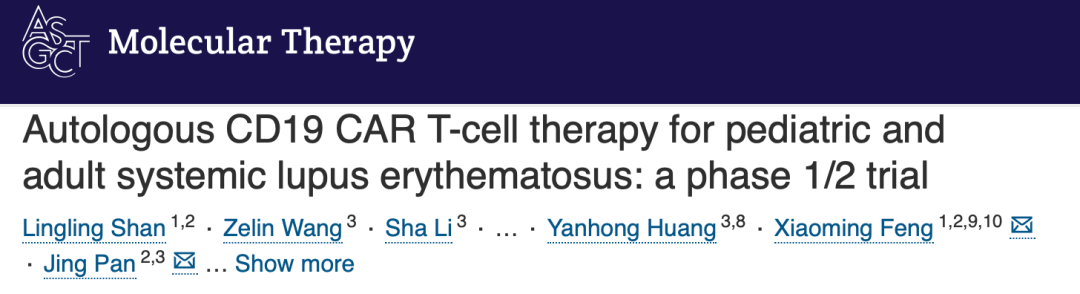
Recently, the team led by Dr. Jing Pan at Beijing GoBroad Hospital, in collaboration with Professor Xiaoming Feng from the School of Basic Medical Sciences at Hangzhou Normal University, published their latest findings in Molecular Therapy. The study, titled “Autologous CD19 CAR T-cell therapy for pediatric and adult systemic lupus erythematosus: a phase 1/2 trial,” presents comprehensive data on the safety and efficacy of CD19 CAR-T therapy in both pediatric and adult patients.
SLE is a chronic autoimmune disease characterized by multisystem involvement. Its pathogenesis is largely driven by the abnormal activation of autoreactive B cells, which continuously produce autoantibodies such as anti-dsDNA antibodies. This immune dysregulation leads to systemic inflammation and progressive organ damage, particularly affecting the kidneys, liver, lungs, and skin. Compared with adults, pediatric patients often exhibit more aggressive disease and face greater risks related to long-term immunosuppressive treatment, including impaired growth and severe complications.
The study was designed as a phase 1/2 clinical trial, consisting of a dose-escalation stage followed by a dose-expansion stage. The primary objectives in phase 1 were to evaluate dose-limiting toxicities and short-term adverse events, while phase 2 focused on treatment efficacy, assessed by objective response rates at 3 and 6 months. To determine the optimal dose, the investigators employed the TITE-BOIN12 design, which allows for a balanced assessment of both safety and therapeutic benefit.
A total of 18 patients were enrolled in the study, including 15 pediatric and 3 adult patients, all of whom had failed at least two prior lines of immunosuppressive therapy. The cohort included patients with diverse clinical manifestations, such as lupus nephritis, autoimmune hemolytic anemia, and immune thrombocytopenia. In addition, several patients with relatively low disease activity but high dependence on medication were included to explore the potential of early intervention.
The recommended dose for phase 2 was established at 1 × 10⁶ CAR-T cells per kilogram. Notably, this dose demonstrated an optimal balance between safety and efficacy, with no dose-limiting toxicities observed during the dose-escalation phase.
In terms of safety, CD19 CAR-T therapy in SLE patients showed a markedly milder profile compared to its use in hematologic malignancies. Most patients experienced only mild cytokine release syndrome, primarily presenting as transient fever. A small number of patients developed mild neurological symptoms, and no severe infections were reported. Although some patients experienced transient cytopenias, these were reversible and manageable.
The efficacy results were encouraging. Among evaluable patients with active disease at baseline, the majority achieved significant clinical responses at 6 months. Overall, 14 out of 18 patients reached DORIS-defined remission, while an additional 2 patients achieved low disease activity status. Importantly, most of these patients were able to discontinue immunosuppressive therapy and maintain remission.
Subgroup analyses further highlighted the benefits in pediatric patients, where a high proportion achieved sustained remission. Patients with lupus nephritis also demonstrated meaningful improvement, including reductions in proteinuria and normalization of serological markers such as complement levels and anti-dsDNA antibodies.
With a median follow-up of over 10 months, the durability of response was notable. The majority of patients maintained remission without ongoing immunosuppressive therapy, with only one reported relapse.
In conclusion, this study provides important evidence supporting the safety and efficacy of autologous CD19 CAR-T therapy in SLE. The findings suggest that early cellular intervention may not only control disease activity but also reduce long-term treatment-related toxicity, offering a promising pathway toward sustained, drug-free remission.


